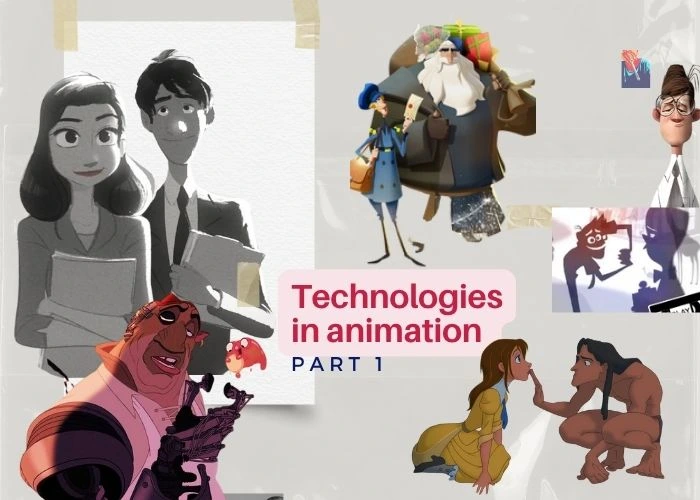
We have come a long way since cavemen painted on rocks. Whatever purpose the activity might have served, aesthetically or otherwise, it’s evident that art has been an indispensable part of human evolution and evolves with the tools available to humankind.
Over the past years, “generative” AI has crept into art spaces, stolen content, and convinced many art noobs that it is the next stage of art evolution. Artists were told to “adapt or die.” So, artists adapted and filed lawsuits.
I believe that technology and the arts go hand in hand, and animation film creators have often expanded their creative vision with the then-available technology or dictated the evolution of one.
This article aims to reveal the technical prowess of some popular studios worldwide that have delivered jaw-dropping animation by expanding the technical boundaries.
Released or not, each masterpiece mentioned below was crafted by code, polished by the studio-developed software, and transcended into timeless artworks.
Paperman x Meander
There are two types of animation enthusiasts: a generation solely raised on CGI, VFX, and OTT platforms, and another that witnessed 2D films from various studios, Blu-ray disks, and eventually 3D. I belong to the latter.
Disney’s Paperman is an Oscar-winning short film released in 2012. It depicts a blooming love between a NY office worker and a woman he meets on the subway. Almost black and white, the film has a papery texture, gradients of grey, pencil-like smudges, strokes, and chalk-like highlights.
Paperman is a 3D film that feels 2D.
Disney Animation Studios built Meander to merge the powers of digital tools and traditional hand-drawn sketches. Directed by John Kahrs, Paperman was rendered on Meander, giving it a papery finish over CGI.
The studio’s documentation about its proprietary software states that Meander was developed to merge vector (scalable) and raster (fixed-dimensional) animation. Initially targeting 2D clean-up animation, Meander evolved into a general-purpose software with its platform-independent library.
Disney later used the platform for other projects like Feast and Moana.
Read about Meander: https://disneyanimation.com/technology/meander-1/
Klaus x KLaS
While Disney used 3D characters to create a 2D feel, Netflix’s project Klaus took the opposite direction. A 2019 film, Klaus, as evident from its name, is a Christmas movie that explores the origins of Santa Claus.
The film feels 3D because the viewer can see the soft edges and light bending on curvatures. But Klaus is a 2D film leveraging lighting and texturing to give it a 3D feel.
3D software programs like Blender have built-in physics engines, enabling animators to mimic real-life movements. Mathematics and GPUs control the physics for bomb blasts, a feather’s trajectory, or an apple falling on the ground that we relish watching on the screens.
It took 300 people, including 40 animators, to get the desired output for this multi-award-winning Christmas film. French studio Les Films du Poisson’s KLaS (Klaus, Lighting, and Shadow) enabled artists to paint with light on 2D drawings with AI assistance for productivity.
Tarzan x Deep Canvas
I am not fond of Tarzan, but it incorporates an important evolution in animation filmmaking – Deep Canvas.
The character of Tarzan is not static. He swings from one place in the jungle to the next, slides on huge branches, swings some more, talks to gorillas, and splashes water. The creative requirements of stimulating such an environment are huge, with an additional ask of making them impactful.
This is where Deep Canvas makes a difference in how viewers experience a film.
The technique enables artists to create 3D environments and merge them with 2D character animation. In the words of the animators involved:
“It is just like taking a camera and moving it through a painting.”
Deep Canvas enabled artists to rotate 3D environments and paint them. This approach is different from 2D because the background is no longer a static painting but an environment that a viewer can experience through the perspective of the 2D animated character.
Treasure Planet x 2D x CGI x Deep Canvas
If there is a film that I will watch on my deathbed, it’s probably Treasure Planet.
One of my favorites from Disney, Treasure Planet, is the perfect mix of adventure, steampunk, 2D, CGI, storytelling, and space pirates! A 90s gift, Treasure Planet is a creative boom, combining Victorian aesthetics, solar-powered ships, moon port city, interactive books, and so much more that it’s criminal not to acknowledge the efforts.
The film blends 2D characters with CGI to enhance character design. While most characters were traditionally drawn, John Silver’s mechanical hand is a popular example, seamlessly blending his 2D body and CGI cyborg arm. The film also uses Deep Canvas and offers space exploration, which almost feels real to the viewer.
Me and My Shadow x Integrating 2D Shadow Characters into 3D Scenes
A film that was never made.
Imagine a shadow world coming to life where they control the caster. An abandoned DreamWorks production, Me and My Shadow, could have been a revolutionary film with the studio’s patented technology for morphing shadows.
The filmmakers planned to have 3D characters and their 2D shadows in the same environment. Since the 2D shadows were to be characters in their own right, the then-technology fell short of addressing the requirement to animate the shadows the same way 3D characters are animated.
DreamWorks addressed the problem with a solution for contouring hand-drawn 2D shadows in a 3D environment.
Read: Me And My Shadow Illuminates DreamWorks Animation’s Patent Department
Final Thoughts
Evolving technologies do not dictate animation. Artists dictate what and how much of the new technical integrations can help achieve the creative vision.
Generative AI has led people to believe that the next level of making art is giving commands. The truth is, a tool will continue to be a tool. Art is a verb, and it must be done.
AD