
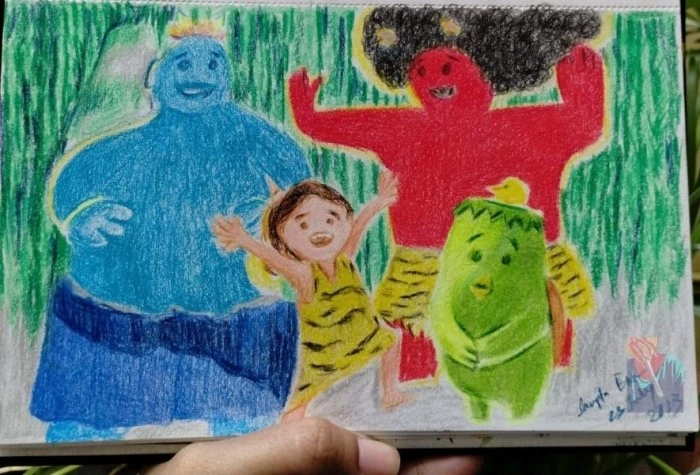
What’s your Kushi Power?
A rather unconventional bit of stop-motion, Oni: Thunder God’s Tale is a limited series from Tonko House based in Berkley, California. Taking inspiration from the Shinto religion, nature spirits, and Japanese folklore, Oni integrates some complex subjects like parenting, being different, and the veil that separates the realm of humans from the gods.
Tonko House was founded by former Pixar art directors – Robert Kondo and Daisuke Tsutsumi in 2014 and is known for the Oscar-nominated short – The Dam Keeper. Oni: The Thunder God’s tale is my introduction to this studio, and here goes its analysis.
AD
Single Parenting Is Tough
Parenting is hard for everyone. Naridon and Mr. Tengu represent opposite ends of the social hierarchy while both try to be single parents to their daughters.
From cooking to keeping the house tidy, Naridon handles the tantrums of a very active child. Through Naridon, Tonko House shows a glimpse of single parenting for an ordinary person.
While we see a goofy, jolly side of Naridon and Onari’s relationship, the other father-daughter duo is portrayed in the exact opposite. Mr. Tengu is not only a teacher but also the father of Amaten. He expects her to maintain the same teacher-student relationship as he has with other students.
The viewers do not see Amaten and Mr. Tengu’s relationship outside school. However, we see Amaten’s struggle to get validation from her father when he puts extra effort into helping Onari develop her Khusi.
While Onari is wild and free like Naridon, Amaten maintains a social decorum like her father. It is reflected in how she conducts herself, her clothing, and her mannerisms, representing the upper class of the Japanese social hierarchy.
Later in the series, when Kappa’s parents rush to Mr. Tengu for their son’s whereabouts, he sends Amaten to Onari’s house to get some information. While Onari isn’t in her house, Amaten notices the kitchen, the walls, and everything rustic in that house and leaves disgruntled.
Amaten is jealous because despite being a good student and having developed her Khushi faster than the rest of the class, from her point of view, the world still revolves around Onari. Thoroughly occupied with the predictions about the Demon Moon, Mr. Tengu fails to see the emotional turmoil of his daughter.
AD
The Spirited Away Nostalgia
Death is the bridge between humans and gods.
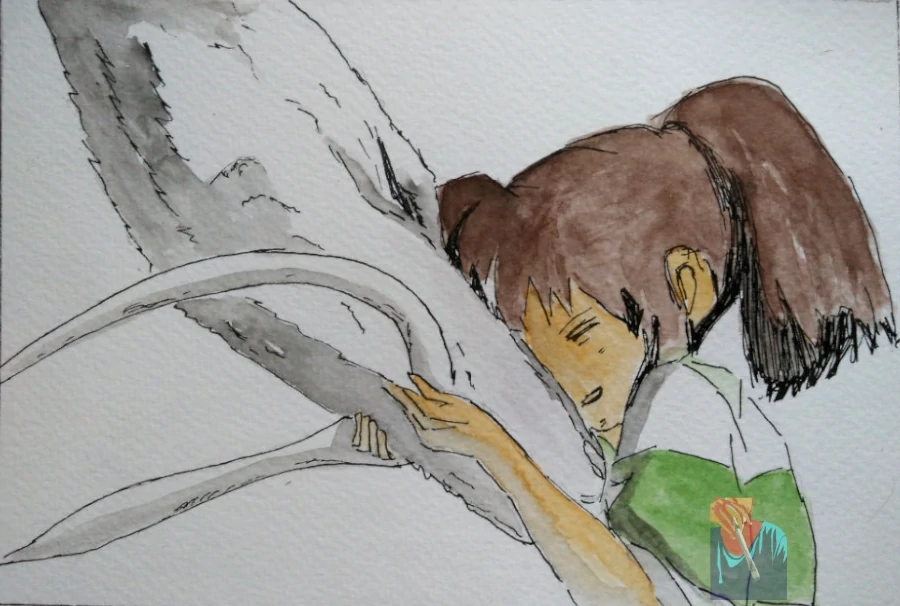
In Spirited Away, Haku tells Chihiro to stop breathing until she reaches the other side of the bridge to the bathhouse. It was essential, a temporary death to mimic that she temporarily belonged to the spirit world that had magically apparated before her, leaving her no minutes to comprehend.
We see an analogy quite early in Oni.
Modori Bridge brought Naridon and infant Onari to the jungle, where the firefly-like Morinoko welcomed them. The forest spirits took it as a signal that the newly arrived pair of strangers was one of them.
On the day Onari and Kappa were to receive Kushi lessons in school, they passed the Modori Bridge not so far from Onari’s house. Both children express their concerns about the sight, and just like Chihiro, Kappa holds his breath, his cheeks puffed by the trapped air.
Kappa later mentions he learned that trick from his grandmother, and that’s how Oni doesn’t find you. It’s like how puffy-faced Chihiro remained invisible to all the spirits crossing the bridge to reach the bathhouse.
The Modori Bridge remains the only entry to the forest, just like the bridge in Spirited Away remains the only way to the bathhouse; both are painted in red which holds spiritual significance in Japan’s Shino religion.
Both stories draw inspiration from the mythologies of the Sanzu river in Mount Osorezan, which is believed to be a gateway to the afterlife as per Japanese folklore.
When viewed from the spirit world, Chihiro’s story is outside-in. Haku’s kindness and companionship help her get a sense of the completely new world and save her from fainting and disappearing. The pair shares many events, including the simple act of sharing rice cakes in the flower garden.
Onari’s story is inside-out, and she experiences similar events on the other side of the bridge. The human world is entirely new to her as she runs into food stalls, mannequins, and game arcades, then faints from exhaustion. She meets Calvin, who is delighted to learn that Yōkai (spirits) are real, and he brings Onari and Kappa into his house.
Later in the series, Calvin and Onari share food similarly but in a completely different set-up. Instead of a garden, the pair looks at a concrete human town while they share a peanut butter and jam sandwich. Onari tears up like Chihiro, and this is one of the most beautiful moments of camaraderie and vulnerability we often see in anime.
AD
Breaking The Generational Curse
Back to the gods, Naridon remains a mysterious character throughout. He is the only Kami in the forest who doesn’t speak. He is also portrayed as a simpleton, a goofball with a substantial disregard for social decorum. His unconditional love for Onari, his playtime in nature, and his smelly farts are the only information we have about him.
Naridon is drawn in the image of Raijin – the Japanese god of thunder and lightning, who also has a brother – Putaro, in the image of Fujin.
Separated from their parents early in their childhoods, the brothers stuck to their nature as the gods of the storms. Up above in the sky, Naridon beat his drum while Putaro made strong winds. We eventually learn that Onari lost her parents in one of the killer storms and got handed to Naridon for safekeeping.
This incident changes Naridon. He becomes aware of the immense power he holds and the damaging capacity of that power. Every day since his entry to Mount Kamigami, he spent it taking care of Onari, being playful, and aiding nature in doing her job. The arrival of his brother doesn’t change it, no matter how much he tries to bring out the intimidating thunder god in him.
Naridon doesn’t give up his role as a single parent. Being Onari’s dad is the single-most important aspect of his being, and he protects it against all odds.
Oni is also a thunder god’s tale of great repentance.
AD
Onari’s Apotheosis
Apotheosis, or becoming god, remains a curious subject in anime or films with Japanese roots. Akira, Neon Genesis Evangelion, and Death Note flirt with the idea but maintain strict boundaries. Humans do not become gods, although they come close to god-like intellect and power.
Under Hayao Miyazaki’s direction, Studio Ghibli draws clear lines with an anti-anthropomorphic approach.
The idea that nature spirits in the form of forests or rivers is deeply rooted in the Japanese Shinto religion, yet apotheosis remains a scantily approached theme.
Onari, on the other hand, undergoes apotheosis as an infant. When Naridon brings her to the forest, the prime spirit bestows her with the same horns as Naridon’s, making her his daughter. She is the only entity in the forest who carries the image of a human, and the spirits do not recognize it.
AD
So, What Is Onari’s Khusi Power?
Oni starts with Khusi power – a special connectedness to the natural world and awareness of one’s nature. Master Tengu, in his first lesson to the class, calls this the first step towards becoming a true Kami.
Onari’s quest about her true nature remains a constantly moving target. Unlike the rest of the spirits of Mount Kamigami, she continually struggles with her identity. She is not a thunder god, her parents are humans, and she is the Oni the Yōkai spirits were trained to fear and fight.
Eventually, she learns she cannot change her past or the circumstances that led her to become who she is. Kappa, the only confidant of Onari, reassures her that she is the best Kami of the village who dared cross the Modori Bridge twice.
Hence, Onari’s Khusi is overcoming fear in whatever shape and form it may present itself.
AD
Final Thoughts
In a limited animation series, Tonko House portrays complex elements in a consumable format while integrating complex themes of childhood, single parenting, finding one’s identity, and the simple yet complex relationship humans share with nature. It is enjoyable both for adults and children.
The core message, however, remains that people fear what they do not understand. People who look different or exhibit quirks are often misunderstood and treated differently in our societies. The languages have developed terms for outsiders and are often passed from elders to children.
Oni: Thunder God’s Tale captures the overconsuming power of fear that quickly turns into hatred. By choosing a school set-up, the creators also hint at this othering behavior passed from generation to generation.
Oni encourages children to question what they are taught and stand against fear and hatred. In an over-connected and yet divided world, this quirky, adorable, and masterful work from Tonko House is the need of the hour.
AD
Way cool! Some very valid points! I appreciate you writing this article plus the rest of the site is really good.